1966 Florence flood
The HummingbirdThe 1966 Florence flood was both a citywide disaster and the reason Probo Carrera missed three consecutive issues of his Urania collection. The books that survived the interruption eventually preserved a private record of his son Giacomo’s arrival, making the flood’s legacy visible not only in what it destroyed but in the accidental traces it left behind.
The Flood and the Missing Issues
The break in Probo’s collecting falls between issue 448, John Wyndham’s The Transfigured, dated November 6, 1966, and issue 452. The absent books were issue 449, Gomorrah and Surroundings by Thomas M. Disch; issue 450, There Is Always a War, an anthology; and issue 451, Mack Reynolds’s And He Cursed the Scandal. Their absence is explained by the emergency: Probo had gone out with the fire brigade on a rubber dinghy to rescue animals stranded on hay rafts, and then helped save books at the National Library while Florence was underwater.
The apparent puzzle is that Probo nevertheless owned issue 448, dated November 6, a date when he had already been working on the flood response for forty-eight hours. The novel’s cover date did not necessarily indicate when it reached a newsstand. Urania issues could be available well before their printed dates; Probo had bought issue 448 thirteen days earlier, before the flood overtook the city. The date on the cover thus records the publication schedule, not the moment the disaster interrupted his routine.
A Long Routine, Broken Once
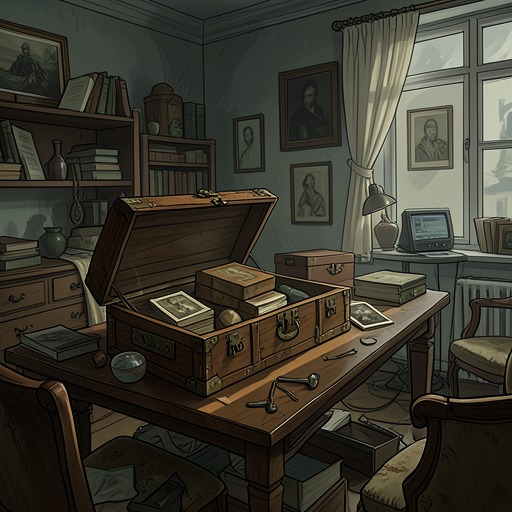
After the three missing numbers, Probo did not miss another issue for fifteen years. His collection continued from issue 452 through issue 899, The Municipalities of 2000, by Mack Reynolds, dated August 23, 1981. He covered the books with tissue paper, read them, and returned each to its orderly place on the shelf. The long run makes the flood’s interruption unusually legible: three absent volumes stand out against hundreds of consecutive purchases.
The last issue also supplies the route by which the flood becomes part of a family story. Giacomo examines the collection and notices Space Infantry, the Italian title for Robert Anson Heinlein’s Starship Troopers. On its title page, in his father’s handwriting, he finds a playful announcement of Giacomo’s arrival, staged as if it were a public presentation. A shelf assembled through years of steady habit has become evidence of a moment the family might otherwise have lost.
Catastrophe Preserved in Family Memory
The flood’s effects extend beyond the missing books. Probo’s absence from the collection is explained through the work of rescuing both animals and books, while the volumes that remain preserve his handwritten account of becoming a father. In this way, a public emergency enters the family record indirectly: through a gap in a series, a rescued book, and writing discovered decades later.
The episode joins catastrophe to contingency without treating the surviving trace as a complete record of the disaster. What it preserves is more modest and more intimate: Probo’s interruption of his collecting, his return to it, and his excitement at Giacomo’s birth. Florence’s submersion is remembered through the ordinary objects that outlast it, and through the absence that makes the ordinary pattern visible again.